Ingredients
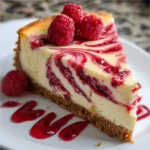
This recipe is divided into three core components: the classic crust, the vibrant raspberry swirl, and the luxuriously creamy cheesecake filling. Using high-quality, room-temperature ingredients is the secret to achieving a flawless texture.
For the Graham Cracker Crust:
- 1 ½ cups (150g) graham cracker crumbs: This is the foundation of your cheesecake. You can buy pre-made crumbs or make your own by pulsing about 10 full sheets of graham crackers in a food processor until they are the consistency of fine sand.
- ¼ cup (50g) granulated sugar: Adds a touch of sweetness to the crust, complementing the buttery and savory notes of the crackers.
- 6 tablespoons (85g) unsalted butter, melted: This is the binding agent that holds the crust together, creating a firm, sliceable base that won’t crumble apart.
For the Raspberry Swirl:
- 1 ½ cups (180g) fresh or frozen raspberries: The star of the show. Fresh raspberries will break down slightly faster, while frozen can be used directly from the freezer, as they will thaw and release their juices while cooking.
- ¼ cup (50g) granulated sugar: Balances the natural tartness of the raspberries, creating a sauce that is both sweet and tangy.
- 1 tablespoon (15ml) fresh lemon juice: Brightens the flavor of the raspberries and helps the sauce thicken slightly by activating the natural pectin in the fruit.
- 1 tablespoon (8g) cornstarch mixed with 1 tablespoon (15ml) cold water: This slurry is a crucial thickening agent, ensuring your swirl has enough body to hold its shape within the cheesecake batter and not simply sink to the bottom.
For the Cheesecake Filling:
- 32 ounces (904g) full-fat block cream cheese, softened to room temperature: This is the most important ingredient. It MUST be full-fat block cream cheese, not the whipped kind in a tub, and it absolutely must be at room temperature to ensure a lump-free, silky-smooth filling. Set it on the counter for at least 4-6 hours before you begin.
- 1 ⅓ cups (265g) granulated sugar: Provides the primary sweetness for the cheesecake, perfectly balancing the tang of the cream cheese and sour cream.
- 1 cup (240g) full-fat sour cream, at room temperature: Adds a delightful tangy flavor and contributes to the ultra-creamy, dense texture of a classic New York-style cheesecake. Room temperature is key to prevent a lumpy batter.
- 2 teaspoons pure vanilla extract: Enhances all the other flavors in the cheesecake, adding a warm, aromatic depth.
- ⅛ teaspoon salt: A tiny amount of salt is essential in sweet recipes to balance the sugar and bring out the complexity of the other ingredients.
- 4 large eggs, at room temperature: Eggs are the primary structure-builder in the cheesecake. Adding them one at a time and mixing minimally ensures the cheesecake bakes up evenly without becoming airy or souffle-like. Again, room temperature is non-negotiable for smooth incorporation.
Instructions
Follow these steps carefully for a perfect, crack-free cheesecake. The process is methodical but not difficult. The keys are patience, room temperature ingredients, and a slow, gentle cooling process.
Step 1: Prepare the Oven and Pan
Preheat your oven to 350°F (175°C). Prepare a 9-inch springform pan. To create a waterproof seal for the water bath, place a large sheet of heavy-duty aluminum foil on your counter, then another sheet on top of it, perpendicular to the first. Place your springform pan in the center and carefully wrap the foil up the sides of the pan, ensuring there are no tears. This will prevent any water from seeping into your crust.
Step 2: Make the Graham Cracker Crust
In a medium bowl, combine the graham cracker crumbs and granulated sugar. Pour in the melted butter and mix with a fork until all the crumbs are evenly moistened, resembling wet sand. Press the mixture firmly and evenly into the bottom and about one inch up the sides of your prepared springform pan. Use the flat bottom of a measuring cup or glass to pack it down tightly. Bake the crust for 10 minutes. Once baked, remove it from the oven and place it on a wire rack to cool completely while you prepare the filling. Once the crust is out, reduce the oven temperature to 325°F (163°C).
Step 3: Create the Raspberry Swirl Sauce
While the crust cools, make the raspberry sauce. In a small saucepan, combine the raspberries, granulated sugar, and lemon juice. Cook over medium heat, stirring occasionally and mashing the berries with the back of a spoon as they warm up. Bring the mixture to a simmer. In a small bowl, whisk together the cornstarch and cold water to create a smooth slurry. Pour the slurry into the simmering raspberry mixture and continue to cook, stirring constantly, for about 1-2 minutes, until the sauce has noticeably thickened. Remove from the heat. For a seedless sauce (highly recommended for a smoother texture), press the mixture through a fine-mesh sieve into a clean bowl, using a spatula to push all the pulp through. Discard the seeds. Set the sauce aside to cool to room temperature.
Step 4: Mix the Cheesecake Filling
In the large bowl of a stand mixer fitted with the paddle attachment, or in a large bowl with a hand mixer, beat the room temperature cream cheese on medium-low speed for about 2-3 minutes, until completely smooth and free of lumps. Scrape down the sides and bottom of the bowl frequently. Add the granulated sugar and salt, and beat on low speed until just combined and smooth. Be careful not to incorporate too much air. Add the room temperature sour cream and vanilla extract, and mix on low speed until fully incorporated. Scrape the bowl again. With the mixer on its lowest speed, add the room temperature eggs one at a time, mixing until each egg is just barely combined before adding the next. Stop mixing as soon as the last streak of yellow disappears. Over-mixing at this stage is the primary cause of cracks, as it incorporates too much air.
Step 5: Assemble and Swirl the Cheesecake
Pour half of the cheesecake batter into the cooled crust and spread it into an even layer. Dollop about half of the cooled raspberry sauce over the batter in random spoonfuls. Use a butter knife or a skewer to gently swirl the sauce into the batter, making a few figure-eight motions. Be careful not to over-mix or you’ll lose the distinct swirl pattern. Pour the remaining cheesecake batter on top, smoothing the surface gently with an offset spatula. Dollop the remaining raspberry sauce on top. Use your clean knife or skewer to create your final, beautiful swirl pattern on the surface of the cheesecake.
Step 6: Prepare the Water Bath and Bake
Bring a kettle or pot of water to a boil. Place your foil-wrapped springform pan into a large roasting pan. Carefully place the roasting pan on the oven rack. Pour the hot water into the roasting pan, being careful not to splash any into the cheesecake, until the water level reaches about halfway up the sides of the springform pan. The water bath (or bain-marie) creates a humid environment in the oven, which is essential for baking the cheesecake gently and evenly, preventing cracks and ensuring a creamy texture. Bake at 325°F (163°C) for 60-75 minutes. The cheesecake is done when the edges are set, but the center 2-3 inches still has a slight jiggle to it (like Jell-O). Do not overbake.
Step 7: The Crucial Cooling Process
This is the most critical step for preventing cracks. Turn the oven off completely, but do not open the oven door. Let the cheesecake cool in the closed oven for 1 hour. After 1 hour, crack the oven door open slightly (you can use a wooden spoon to prop it open) and let the cheesecake cool in the oven for another hour. This slow, gradual cooling process prevents the cheesecake from shocking and contracting too quickly, which is what causes surface cracks. After the second hour, remove the cheesecake from the roasting pan and water bath. Remove the foil wrapping. Let it cool completely on a wire rack at room temperature.
Step 8: Chill Thoroughly
Once the cheesecake has reached room temperature, loosely cover it with plastic wrap (don’t let the wrap touch the surface) and transfer it to the refrigerator. Chill for at least 6 hours, but preferably overnight. This final chilling period is non-negotiable; it allows the cheesecake to fully set, making it sliceable and developing its full, rich flavor and creamy texture. Do not rush this step!
Nutrition
- Serving Size: one normal portion
- Calories: 550