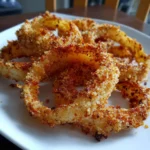
Ingredients
- Large Sweet Onions (2): The star of the show. Varieties like Vidalia, Walla Walla, or other sweet yellow onions are ideal as they have a higher sugar content and lower sulfur content, resulting in a sweet, non-acrid flavor when cooked.
- All-Purpose Flour (1 cup): This forms the base layer of our coating, giving the egg something to adhere to.
- Smoked Paprika (2 teaspoons): Adds a beautiful color and a subtle, smoky depth of flavor that complements the sweet onion.
- Garlic Powder (2 teaspoons): Provides a savory, aromatic foundation to the breading.
- Salt (1 ½ teaspoons, divided): Essential for seasoning every layer of the recipe, from the flour dredge to the final Panko crust.
- Black Pepper (1 teaspoon): Freshly ground black pepper adds a mild, pungent kick.
- Large Eggs (3): Acts as the crucial binder, helping the Panko breadcrumbs stick firmly to the onion rings.
- Panko Breadcrumbs (3 cups): This is the non-negotiable secret to ultimate crispiness. These Japanese-style breadcrumbs are flakier and lighter than traditional breadcrumbs, so they absorb less oil (or in this case, moisture) and bake up incredibly crunchy.
- Olive Oil or Avocado Oil Spray: A light mist of oil helps the Panko to brown evenly and achieve that fried-like texture in the oven.
Instructions
Follow these detailed steps carefully to ensure your onion rings are perfectly coated and bake to a crispy, golden-brown finish. The process is broken down into preparation, breading, and baking for clarity.
Step 1: Prepare the Onions and Oven
First, position your oven racks in the upper-middle and lower-middle positions. Preheat your oven to 425°F (220°C). A high temperature is crucial for quickly crisping the exterior. Line two large baking sheets with parchment paper. Parchment paper prevents sticking and makes cleanup a breeze. Lightly spray the parchment paper with olive oil spray.
Next, prepare your onions. Peel the dry, papery outer layers from the onions. Slice them crosswise into thick rings, about ½-inch to ¾-inch thick. Thinner rings can burn, while thicker ones may not cook through. Carefully separate the slices into individual rings. Reserve the smaller, center pieces for another use like soups or stocks. For an optional step that helps mellow the onion flavor even more, you can place the separated rings in a bowl of cold water or milk for about 15-20 minutes, then drain and pat them completely dry with paper towels. This step is not mandatory but can result in a sweeter, more tender final product.
Step 2: Set Up the Breading Station
Proper organization is key to a smooth and mess-free breading process. You will need three shallow dishes or pie plates.
- Dish 1 (Flour Mixture): In the first dish, whisk together the 1 cup of all-purpose flour, smoked paprika, garlic powder, 1 teaspoon of salt, and 1 teaspoon of black pepper until thoroughly combined.
- Dish 2 (Egg Wash): In the second dish, crack the 3 large eggs and whisk them vigorously until the yolks and whites are completely blended and slightly frothy.
- Dish 3 (Panko Mixture): In the third dish, combine the 3 cups of Panko breadcrumbs with the remaining ½ teaspoon of salt. Mix well to ensure the salt is evenly distributed.
Arrange your three dishes in an assembly line: flour, then egg, then Panko, with your prepared baking sheets at the very end.
Step 3: The Three-Stage Breading Process
This is the most critical part of the recipe for achieving a coating that sticks. It’s helpful to use one hand for the dry ingredients (flour, Panko) and the other hand for the wet ingredient (egg) to prevent your fingers from becoming heavily coated.
- Dredge in Flour: Take one onion ring and place it in the flour mixture. Toss it gently to coat it completely on all sides, including the inside and outside edges. Tap off any excess flour. A light, even coating is all you need.
- Dip in Egg: Transfer the flour-coated ring to the egg wash. Submerge it completely, ensuring the entire surface is wet. Allow any excess egg to drip back into the dish for a second or two. The flour coating helps the egg adhere perfectly.
- Coat with Panko: Immediately move the egg-dipped ring to the Panko mixture. Press the Panko firmly onto all surfaces of the ring. Be generous here; you want a thick, even crust. The firm pressure helps the Panko lock onto the egg wash.
- Arrange on Baking Sheet: Place the fully breaded onion ring on one of the prepared baking sheets. Repeat this process with the remaining onion rings, arranging them in a single, even layer. Do not let the rings touch or overlap, as this will cause them to steam instead of crisp up. Leave at least an inch of space between each ring.
Step 4: Bake to Golden Perfection
Once all your rings are breaded and arranged on the baking sheets, give them a final, light misting with the olive oil or avocado oil spray. This helps them achieve a beautiful golden-brown color and enhances the crispiness.
Place the baking sheets in the preheated 425°F oven. Bake for 10-12 minutes. Then, carefully remove the sheets from the oven. Using tongs, flip each onion ring over. Rotate the baking sheets, moving the top one to the bottom rack and the bottom one to the top rack to ensure even cooking and browning.
Return the sheets to the oven and bake for another 8-10 minutes, or until the onion rings are a deep golden-brown and wonderfully crispy. Keep a close eye on them during the last few minutes, as Panko can go from golden to burnt quite quickly.
Once baked, remove them from the oven and let them cool on the baking sheets for a minute or two before transferring them to a wire rack. Serve immediately for the best possible texture.
Nutrition
- Serving Size: one normal portion
- Calories: 280